

TL;DR: A scalable creative strategy is a production system that generates, tests, and iterates ad creative fast enough to outpace platform fatigue cycles. Meta’s data science team now attributes 56% of campaign performance to creative quality, yet most brands still treat creative as a design task. The fix is modular production with structured testing, funnel-aligned messaging, and format diversity baked into every cycle, with test volume and the size of each test matched to the stage of the account.
The Bottleneck Nobody Talks About
Every month I speak to e-commerce founders spending six figures on paid social who are stuck at the same revenue ceiling. They have tried expanding to new platforms, tested every audience combination Meta offers, handed their budgets to Advantage+ Shopping, and still the numbers plateau. When I look at their accounts, the answer is almost always the same. They do not have a creative problem. They have a creative production problem.
The distinction matters. A creative problem means your ads are bad. A creative production problem means you cannot make enough good ads, fast enough, across enough formats, to keep the algorithm fed. In 2026, those are entirely different challenges, and the second one is harder to solve because it requires systems thinking, not just talent.
Meta’s Andromeda algorithm update changed the economics of paid media permanently. The algorithm now evaluates thousands of creative permutations simultaneously, cycling through your assets faster than any previous system. Creative fatigue that used to set in after four weeks now hits in two to three. If you were refreshing monthly, you went from twelve production cycles a year to twenty-six. Most teams were not built for that pace. The ones who figured it out are scaling. Everyone else is watching CPAs climb and wondering what happened.
What a Scalable Creative Strategy Actually Is
A scalable creative strategy is a repeatable system for producing, testing, and graduating ad creative across funnel stages and formats at the velocity your spend level demands. It is not a mood board. It is not a quarterly brand shoot. It is infrastructure.
The word “scalable” is doing specific work in that definition. It means the system’s output can grow without a proportional increase in cost or headcount. Producing ten ads a month with a three-person team is a process. Producing forty ads a month with the same team and a 30% budget increase is a scalable system. The difference is almost always structural: modular production, templatised workflows, and clear decision rules that remove bottlenecks from the creative cycle.
The data makes the urgency clear. Brands testing twenty or more new creatives monthly achieve 65% higher ROAS than those testing fewer. That is not a marginal improvement. That is the difference between a brand that grows and a brand that treads water. And the gap is widening as platform algorithms get better at exploiting creative diversity and punishing creative stagnation.
Why Most E-Commerce Brands Hit the Creative Wall
There are three structural reasons e-commerce brands fail to scale creative, and none of them have anything to do with design talent.
The Single-Source Dependency
The most common failure pattern is building your entire creative pipeline around one production source. A single freelance designer. One video production agency. An in-house team of two. When everything flows through one bottleneck, output is capped by that bottleneck’s capacity, and the quality variance is minimal because every piece carries the same creative DNA.
The algorithm does not reward consistency. It rewards diversity. Advertisers running one ad set with twenty-five diverse creatives outperformed those running five ad sets of five similar creatives by 17% on conversions and 16% on cost efficiency. Five variations of the same static product shot are not creative diversity. They are volume masquerading as strategy.
The Campaign-Thinking Trap
Most teams plan creative around campaigns: a launch, a seasonal sale, a new product drop. They batch-produce a set of assets, run them until performance declines, then scramble to produce the next batch. This creates a boom-and-bust cycle where creative quality is highest at launch and degrades steadily until the next production sprint.
Scalable creative does not work in campaigns. It works in cycles. A continuous two-week rhythm where new creative enters the pipeline before old creative fatigues, testing runs alongside scaling, and learnings from one cycle feed directly into the brief for the next. The shift from campaign thinking to cycle thinking is the single biggest operational change most brands need to make.
The Missing Middle Layer
Most e-commerce teams have a media buyer and a designer. What they are missing is the creative strategist: the person who translates performance data into creative briefs, maps messaging to funnel stages, and decides what to test next based on what the data is actually saying. Without this role, the media buyer is making creative decisions based on platform metrics alone, and the designer is working from briefs that describe what the ad should look like rather than what it needs to accomplish.
The creative strategist is the connective tissue between performance and production. When this role does not exist, creative decisions happen by default rather than by design, and the team optimises for aesthetics when they should be optimising for outcomes.
The Four Pillars of a Scalable Creative System
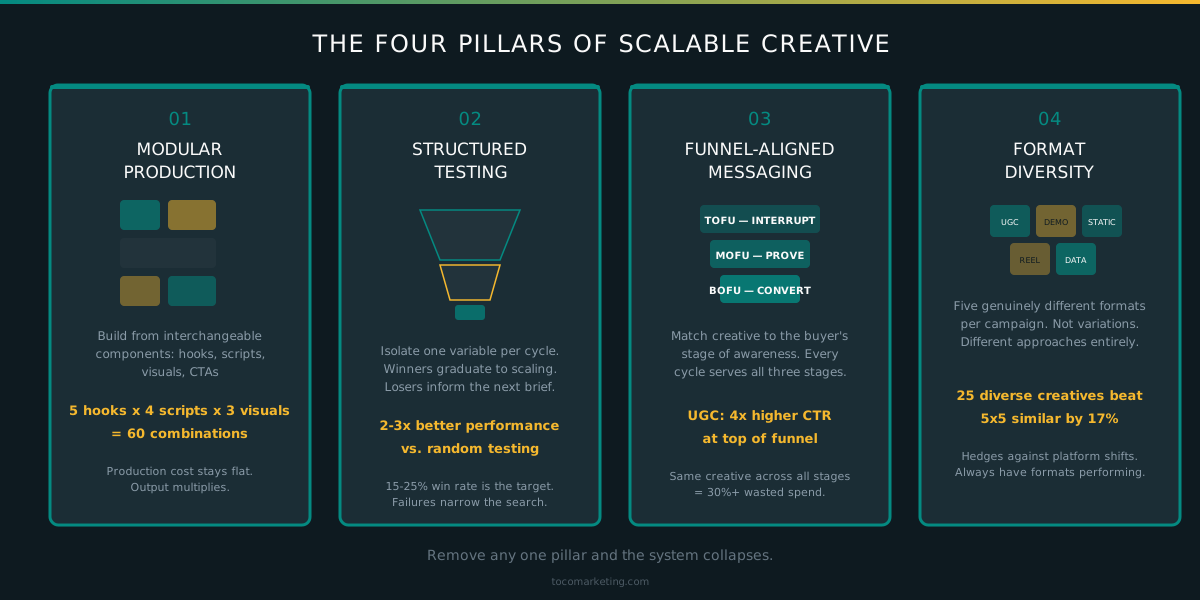
I build creative systems for e-commerce brands at Toco, and every one of them rests on four pillars. Remove any one and the system eventually collapses.
Pillar 1: Modular Production
Modular production means building creative from interchangeable components rather than producing each ad as a standalone asset. A hook, a body script, a visual treatment, a call-to-action. Each element exists independently and can be combined with any other element to produce a distinct creative variant.
The maths explains why this matters. If you produce five hooks, four body scripts, and three visual treatments, you have sixty potential combinations from twelve components. Producing sixty standalone ads would take weeks. Assembling sixty modular combinations takes hours. The production cost stays roughly flat while output multiplies.
This approach works across formats. A UGC video uses a creator hook, a product demonstration body, and a promotional CTA. A static image uses a headline hook, a benefit-focused body, and a scarcity CTA. The modules are format-specific, but the principle is universal: create the building blocks once, assemble them in different configurations, and let the algorithm find the winners.
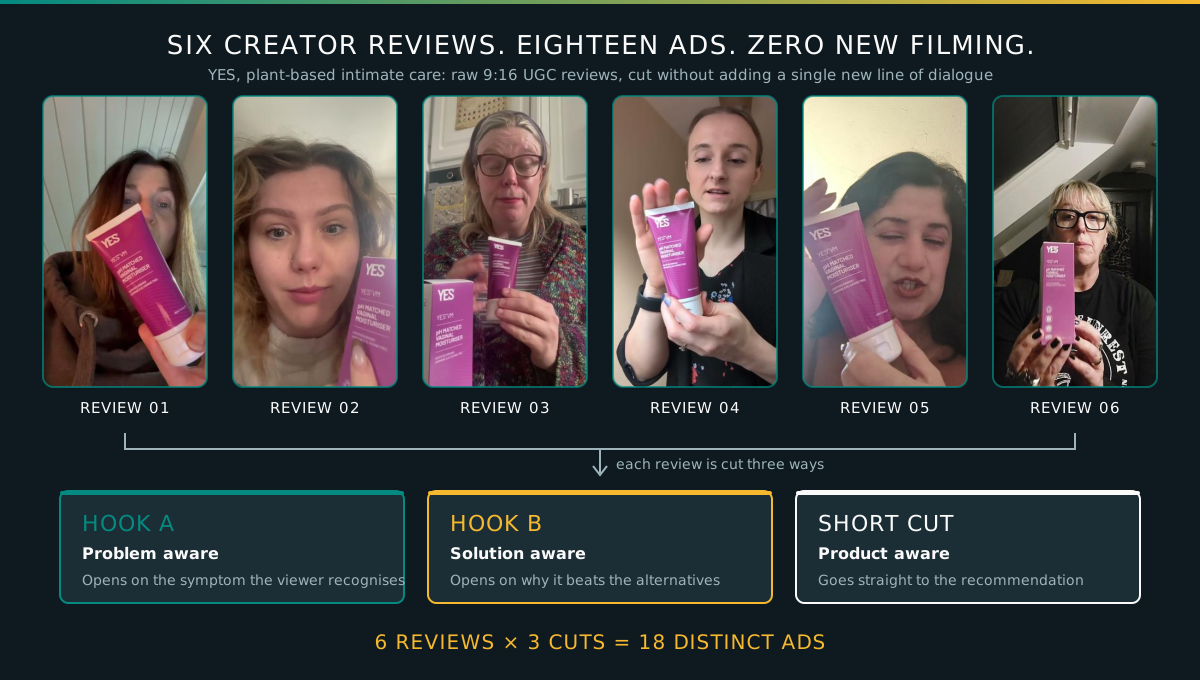
Here is what that looks like in practice. For YES, a plant-based intimate care brand, we started with six raw video reviews from UGC creators. Rather than briefing new shoots, we cut each review three ways without adding a single new line of dialogue: a problem-aware hook that opens on the symptom, a solution-aware hook that opens on why the product beats the alternatives, and a short cut that goes straight to the recommendation. Six pieces of footage became eighteen distinct ads, each one mapped to a stage of awareness.
Pillar 2: Structured Testing
Producing forty creatives a month means nothing if you cannot tell which ones work and why. Structured testing isolates one variable per test cycle so you can attribute performance changes to specific creative decisions rather than guessing.
The framework I use at Toco runs on a simple cadence. Each two-week cycle tests one variable: the hook, the format, the value proposition, the visual style, or the audience alignment. New creatives enter a dedicated testing campaign with clear success criteria defined before launch. Winners graduate to the scaling campaigns. Losers get analysed for learnings and retired.
Match the Test to the Account’s Stage
How much you test, and how big the differences between your tests should be, depends on where the account is in its life. A brand spending £5k a month and a brand spending £200k a month should not be running the same kind of tests, even if they follow the same cycle.
Smaller and younger accounts should test big swings. They have not found their winners yet, so there is nothing proven to iterate on, and they rarely have the conversion volume to detect a small lift. A new headline on the same video might be 5% better, but with a handful of conversions per ad that difference is indistinguishable from noise. What a young account needs is large, obvious differences: a new angle, a new persona, a new format, a new value proposition. These are the tests that find a foothold, and because the gap between a good concept and a bad one is wide, the data can actually call a winner. It also means a larger share of the budget goes to testing. As I cover in how to size creative volume to your budget, an account still in discovery can put the majority of its spend into finding winners.
Larger and more mature accounts earn the right to test smaller variations. They already have proven concepts, and they have enough conversions to measure a modest improvement with confidence. At that scale, optimisation is where the money is: a new hook on a winning body, a tighter first three seconds, a different thumbnail, a shorter cut, a sharper CTA. A 10% improvement on an ad already spending £50k a month is often worth more than a promising new concept that may never scale. The testing share of budget drops accordingly, towards 20% and rarely below 10%, with most spend pressing the advantage of what already works. Mature accounts should still reserve some of that testing budget for bold new concepts, because every winner eventually fatigues and iterations alone will not replace it.
The simplest way to hold both ideas together: young accounts are searching for their first winners, so they test concepts. Mature accounts are compounding the winners they have, so they test iterations.
Analysis across 50,000 creative tests and 200+ DTC brands found that systematic testing drives two to three times better performance than random or intuition-based testing. The performance gap between brands that test systematically and brands that guess is not subtle. It is the kind of gap that determines whether a brand scales or stalls.
Top-performing brands in 2026 target a 15% to 25% test win rate. That means 75% to 85% of your tests will fail, and that is not a problem. It is the system working as designed. Each failure narrows the search space. Each winner compounds the learnings.
Pillar 3: Funnel-Aligned Messaging
A scalable system does not just produce more creative. It produces the right creative for each stage of the buyer journey. Running a product demo to a cold audience is as wasteful as running a brand story to someone who abandoned their cart yesterday. The creative has to match the buyer’s level of awareness.
At the top of the funnel, creative needs to interrupt, provoke recognition, and earn attention without asking for anything. Format diversity matters most here because you are testing which angles resonate with people who do not yet know they have a problem. UGC-style content performs particularly well at this stage: UGC-based ads generate four times higher click-through rates than standard branded ads and cost significantly less to produce.
In the middle of the funnel, creative needs to build credibility through proof. Testimonials, case studies, product demonstrations, comparison content. The job is to move people from “that’s interesting” to “I believe this works.” Short-form video between six and fifteen seconds performs 41% better than longer formats at this stage because attention is earned, not guaranteed.
At the bottom of the funnel, creative needs to remove the last objection and make the next step effortless. Promotional offers, urgency signals, social proof density. Every element should reduce friction, and the creative should feel like the obvious next step rather than a hard sell.
A scalable system produces creative for all three stages in every production cycle. If your creative calendar only produces top-of-funnel content, your mid-funnel starves. If you only produce bottom-funnel promotional ads, your pipeline dries up.
Pillar 4: Format Diversity
Format monotony is the quiet killer of creative performance. When every ad in your account looks the same, whether that is all static images, all studio video, or all text-overlay graphics, the algorithm has nothing to work with. Genuine diversity means genuinely different approaches: a founder-led video alongside a product demo alongside a UGC testimonial alongside a data-driven static alongside a lifestyle reel.
The benchmark I set for clients is a minimum of five distinct creative formats running in every campaign. Not five variations of the same format. Five formats that look, sound, and feel completely different from each other. This gives the algorithm room to find winners across different audience segments and placements without you having to micromanage where each ad appears.
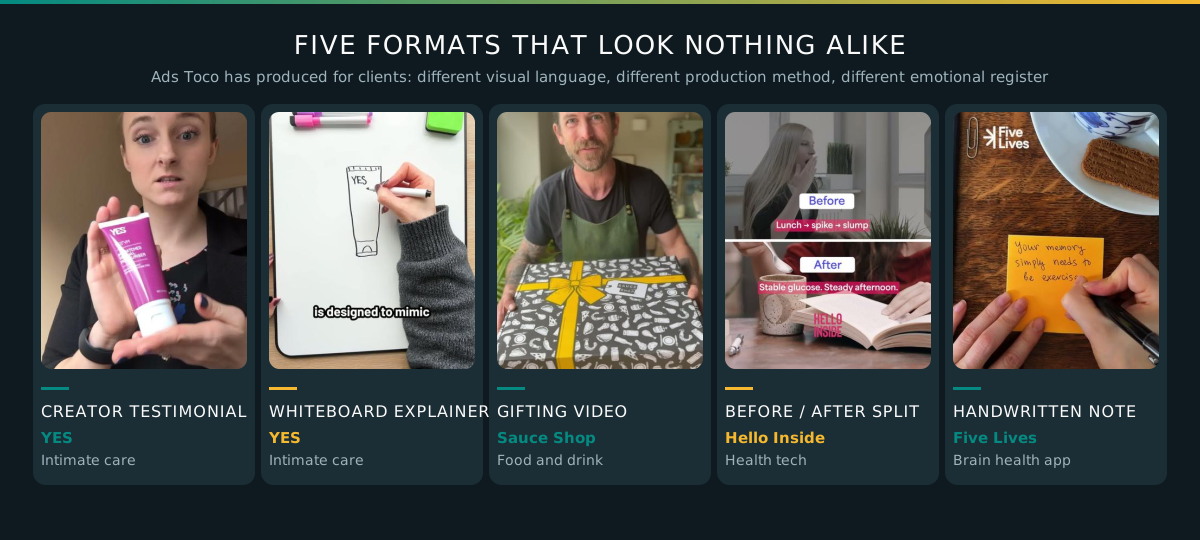
To make that concrete, here are five formats we have produced for clients. A creator testimonial, a whiteboard explainer, a gifting video, a before-and-after split screen, and a handwritten note. None of them could be mistaken for another. Each uses a different production method and speaks in a different visual language, which is exactly the kind of variety the algorithm needs to work with.
Format diversity also insulates you against platform changes. When Meta shifts how it weights video versus static, or when a particular format starts fatiguing faster across the platform, your account has other formats already performing. You are hedged by default rather than scrambling to pivot.
The Production Cadence: What a Cycle Actually Looks Like
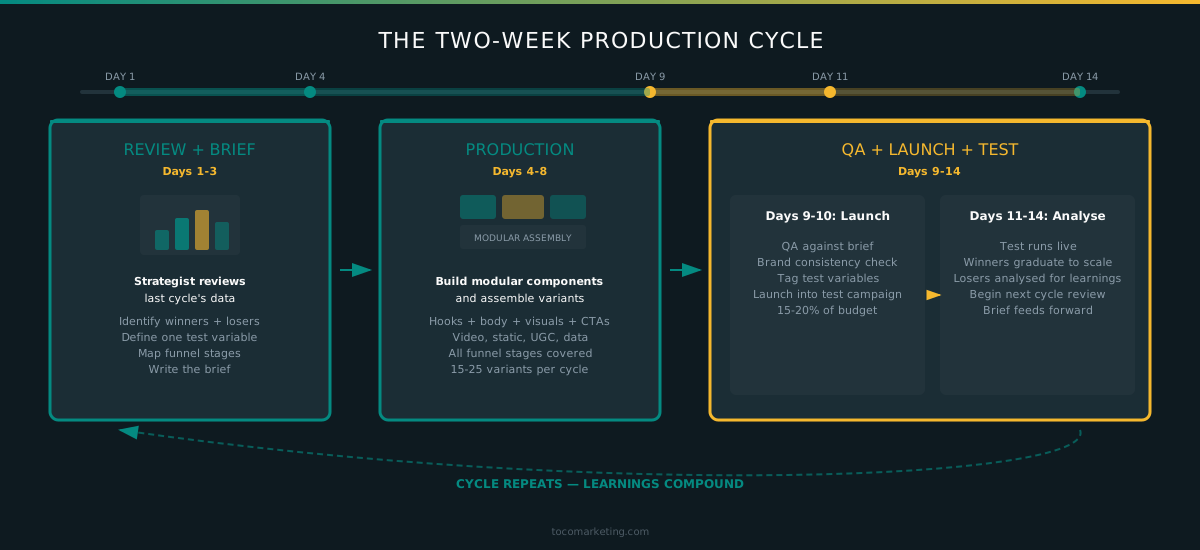
Here is the two-week production cycle I run for e-commerce brands spending over £50k a month on paid social.
In the first three days, the creative strategist reviews performance data from the previous cycle. They identify which hooks, formats, and messages won, which lost, and what the data suggests testing next. That analysis becomes the brief for the new cycle. The brief specifies one test variable, three to five concepts to produce, and the funnel stages each concept targets.
Days four through eight are production. The design team builds modular components: hooks, body copy, visual treatments, CTAs. For video content, this means scripting, shooting or sourcing UGC, and editing. For static content, this means layout, copy integration, and format adaptation. The modular approach means a single production sprint yields fifteen to twenty-five distinct creative variants from a smaller number of base components.
Days nine and ten are QA and launch. Every creative gets reviewed against the brief, checked for brand consistency, and tagged with its test variable, funnel stage, and format type. The batch launches into the testing campaign with defined success metrics and a clear promotion path.
Days eleven through fourteen, the test runs while the strategist begins the performance review that will inform the next cycle’s brief. Winners are promoted to scaling campaigns. The cycle begins again.
For brands spending under £50k a month, the cadence can stretch to three weeks, and the volume drops to eight to twelve variants per cycle. Those variants should also be further apart: fewer ads, but bigger differences between them, so each test has a real chance of producing a clear result. The structure stays the same. What changes is the pace and the size of the swings, not the principle.
The Three Tests Every Creative Must Pass
Before any creative enters the testing pipeline, it has to clear three qualitative checks. These take less than a minute each and catch the mistakes that waste budget.
The Thumb-Stop Test asks whether the creative earns attention in the first 1.5 seconds. Show it to someone who has never seen it, give them two seconds, and ask what it is about. If they cannot answer, the hook is too weak. Hook rates in 2026 benchmark at 28% on Meta and 33% on TikTok. If your creative consistently falls below those numbers, your hooks are the problem, and no amount of media buying optimisation will fix them.
The Funnel-Fit Test asks whether the creative makes sense for its assigned stage. Read the ad as if you were the intended viewer at that moment in their journey. Does a top-of-funnel piece name a recognisable problem? Does a mid-funnel piece provide proof? Does a bottom-of-funnel piece make action obvious? If the creative would work equally well for all three stages, it is not specific enough for any of them.
The Diversity Check asks whether this creative genuinely differs from what is already running. For a young account, that means a meaningfully different approach in format, angle, or emotional register, not a colour variation or a headline swap. If the new ad could be mistaken for something already in the account, it is not adding the diversity the algorithm needs. Mature accounts are the exception: a new hook on a proven winner is a legitimate test for them, as long as it is labelled as an iteration and sits alongside genuinely new concepts rather than replacing them.
Common Mistakes That Keep Creative Systems Broken
Confusing Speed With Scale
Producing creative faster is not the same as producing creative at scale. Speed without structure just generates more untested assets that clog the account with noise. Scale means a repeatable system with feedback loops, where every cycle is informed by the last and production capacity grows without proportional cost. If your response to declining performance is “make more ads,” you have confused the symptom with the solution.
Treating AI as a Replacement Instead of an Accelerator
Over 91% of creators now use generative AI to assist with content production, and for good reason. AI dramatically reduces the time cost of producing variations, generating copy, and adapting assets across formats. But the brands getting hurt are the ones using AI to replace strategy rather than amplify it. AI can produce a hundred ad variations in a day. Without a testing framework and creative direction, that is a hundred pieces of noise. The winning approach is a hybrid model: AI handles 70% of the testing volume to find winning patterns quickly, while human creative energy is reserved for the hero concepts and strategic direction that the algorithm cannot generate on its own.
Ignoring the Feedback Loop
The most expensive mistake is producing creative in a vacuum. When the production team never sees performance data, they keep making the same mistakes. When the media buyer never communicates what is working to the creative team, winning patterns go unexploited. The feedback loop between performance data and creative production is what turns a content factory into a scalable system. Every cycle should start with a review of what the data said, and every brief should cite the specific learnings that shaped it.
Where to Start This Week
If your creative production currently consists of making a few new ads when the old ones stop working, here is the sequence I would follow to build toward a scalable system.
Start with an audit of what you have. Count the number of genuinely distinct creative formats currently active in your account. Count the number of new creatives you launched in the past thirty days. Check your average frequency across active ads. If your format count is below five, your monthly creative count is below fifteen, or your frequency is above 2.5 on any active ad, you have a production deficit.
Next, build the brief template. Every production cycle needs a one-page brief that specifies the test variable, the funnel stages being served, the number of concepts to produce, and the success criteria for the test. The brief is the heartbeat of the system. Without it, production defaults to “make things that look nice” rather than “make things that answer a specific strategic question.”
Then run your first cycle. Start by being honest about the stage of your account. If you are still looking for your first reliable winners, pick a big variable, such as a new angle, format, or value proposition, and give testing a generous share of budget. If you already have proven winners and healthy conversion volume, pick a smaller variable, such as the hook or the opening seconds of a winning ad, and keep most of your spend on scaling. Produce eight to twelve modular variants. Launch them into a dedicated testing campaign. Let the test run for its full cycle before making decisions. Review the data. Write the next brief. Repeat.
The system gets better with every cycle because the learnings compound. Your second brief is sharper than your first because it is built on actual data. Your fifth cycle produces higher win rates because four cycles of testing have narrowed the search space. By the tenth cycle, you are making creative decisions with a dataset most brands never build because they never stopped guessing long enough to start measuring.
Creative is not a department. It is the operating system of modern e-commerce advertising. In a world where Meta’s algorithm handles targeting, bidding, and placement automatically and global social ad spend has surged to $334.5 billion, creative strategy is the only lever you fully control. Every week you spend producing creative without a system is a week of compounding inefficiency you will never recover.
Sources
- SuperAds — Why Creative Diversity Is the #1 Performance Lever in 2026 — Meta data science attribution of 56% of performance outcomes to creative quality, and creative diversity outperformance data.
- Benly — Ad Creative Benchmarks 2026: CTR, Hook Rate & More — Hook rate benchmarks across platforms, short-form video performance advantage, and 65% ROAS lift for brands testing 20+ creatives monthly.
- Zentric Digital — The Creative Fatigue Playbook — Creative fatigue acceleration under Andromeda, now hitting in 2-3 weeks versus 4+ weeks in 2024.
- ATTN Agency — Systematic Creative Testing: The Data-Driven Approach — Analysis of 50,000+ creative tests across 200+ DTC brands showing 2-3x performance advantage from systematic testing.
- inBeat Agency — 75 Creator Economy Statistics 2026 — 91% of creators using generative AI, and UGC performance statistics.
- inBeat Agency — 50+ Social Commerce Statistics 2026 — UGC ads generating 4x higher click-through rates than standard branded ads.
- Segwise — Meta Andromeda Update: 2026 Creative Strategy Playbook — Andromeda rollout timeline and creative diversity as the new audience segmentation.
- Ringly.io — 47 Social Commerce Statistics 2026 — Global social media advertising spend reaching $334.5 billion in 2026.
At Toco Marketing, we specialise in growth and marketing strategies that deliver measurable results. Want to drive more engagement and conversions? Book a chat today, and let’s build a strategy that works for your business!