
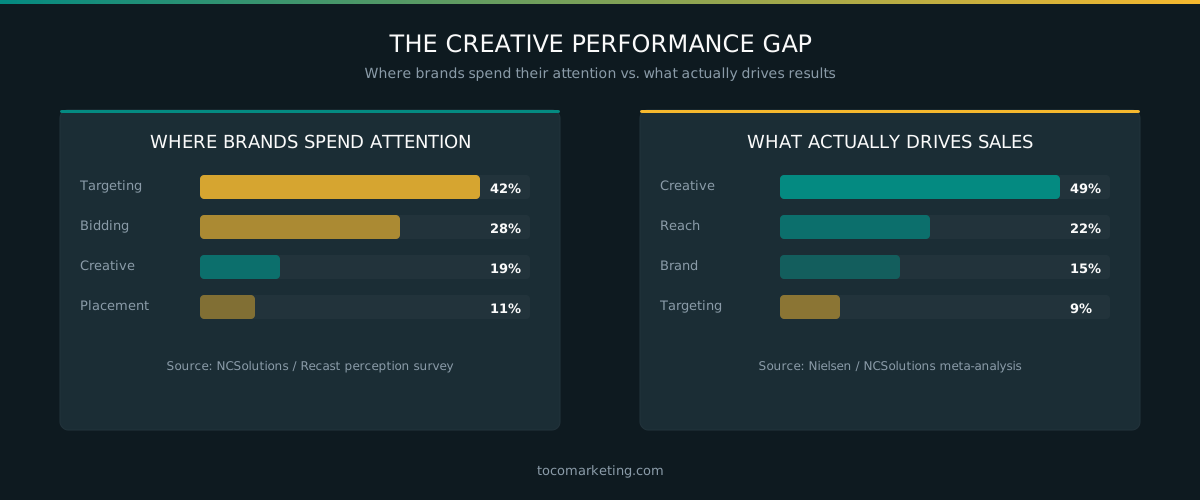
TL;DR: Your ad creative is likely failing because you’re treating it as decoration rather than strategy. Nielsen research found that creative drives 49% of a campaign’s sales lift, yet most brands allocate less than a fifth of their attention to it. The fix isn’t more ads. It’s building a creative system that diagnoses why ads fail and replaces guesswork with structured testing, funnel-aligned messaging, and disciplined diversity.
The Expensive Assumption Nobody Questions
Every week I audit ad accounts for brands spending anywhere from £50k to £500k a month on paid social. The pattern is almost always the same. Performance has declined over the past four to six weeks. The media buyer has already tried duplicating campaigns, adjusting bids, expanding audiences, and swapping placements. None of it worked. And in every single case, the real problem is sitting in plain sight inside the creative tab.
The industry has spent years training marketers to think about ads as a targeting problem. Pick the right audience, set the right bid, choose the right objective. Creative was the afterthought, the thing the design team threw together on a Friday afternoon. That mindset was already flawed, but in 2026 it is actively destructive. Meta’s Andromeda algorithm update fundamentally shifted the performance equation. Their own data science team now attributes 56% of all campaign performance outcomes to creative quality, more than targeting, budget, placement, and timing combined.
If you are still spending 80% of your time on media buying and 20% on creative, you have the ratio backwards.
What “Failing Creative” Actually Means
When I say your creative is failing, I don’t mean it looks bad. Some of the worst-performing ads I’ve ever audited were beautifully designed. The failure is functional, not aesthetic. It means your ads are not doing the job they were built to do at the specific stage of the buyer journey where they appear.
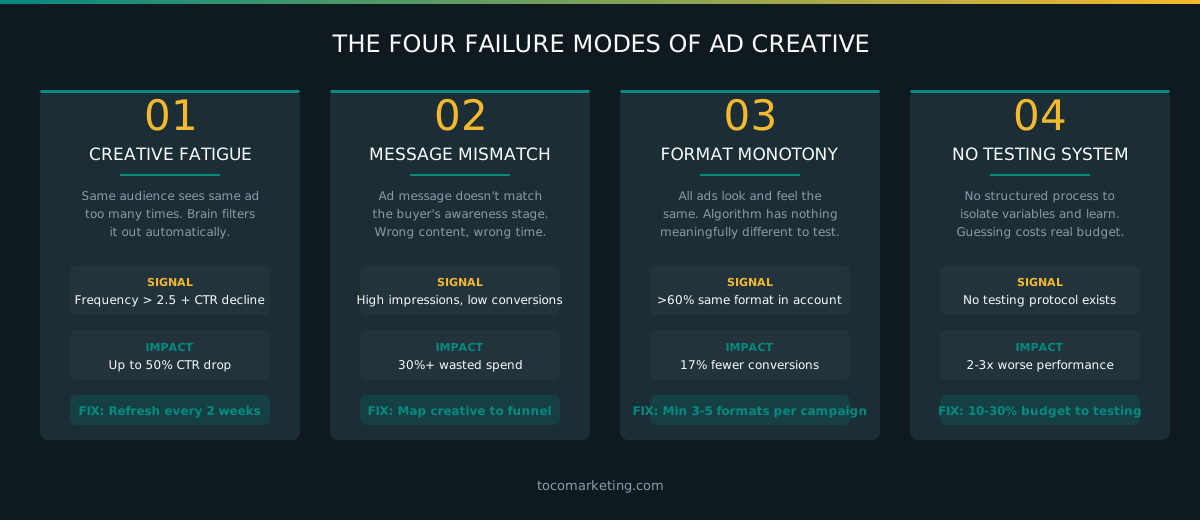
Failing creative shows up in the data as declining click-through rates, rising cost per acquisition, frequency creeping above 2.5 with no corresponding lift in conversions, and thumb-stop rates below 25% on video. But the data is the symptom. The cause is almost always one of four structural problems: creative fatigue, message-market mismatch, format monotony, or the absence of a testing system.
Understanding which failure mode you’re dealing with is the first step to fixing it. Running the same diagnostic for every underperforming campaign is like prescribing the same medication for every patient who walks through the door.
The Four Failure Modes of Ad Creative
Failure Mode 1: Creative Fatigue
Creative fatigue is the silent killer of paid media performance. It happens when the same audience sees the same ad too many times, and the brain’s natural defence mechanism kicks in. People stop seeing your ad entirely. Not because they chose to ignore it, but because their visual processing system filtered it out before conscious attention ever engaged.
The numbers are stark. According to research compiled by Shno, click-through rates decrease by up to 50% when creative fatigue sets in. After four repeated exposures, conversion likelihood drops by roughly 45%. And consumers who experience ad fatigue are 22% less likely to recommend the brand afterwards. You are not just losing the click. You are eroding brand equity every time a fatigued ad gets served.
The trigger point has moved closer than most teams realise. In 2024, you could get away with refreshing creative every three to four weeks. In 2026, the acceleration of AI-generated content has flooded every platform with novel stimuli. Your audience’s threshold for repetition has dropped accordingly. The frequency threshold that triggers performance decline is now around 2.5 for most industries, and brands that refresh creative every two weeks maintain 40% higher CTR than those refreshing monthly.
The fix for fatigue is not making one new ad when performance drops. It is building a production pipeline that generates fresh creative before the old batch burns out.
Failure Mode 2: Message-Market Mismatch
Of all four failure modes, I see this one most often in accounts that look healthy on the surface. The ads are well-produced, the copy is clear, the offer is real. But the message does not match the audience’s level of awareness.
Running a product demo to someone who doesn’t know they have a problem is like handing a menu to someone who hasn’t decided they’re hungry. Running a brand awareness video to someone who visited your pricing page yesterday is equally wasteful. The creative needs to meet the buyer where they are, not where you wish they were.
At the top of the funnel, creative needs to name the problem, provoke recognition, and earn attention without asking for anything in return. In the middle, it needs to build credibility through proof, whether that is testimonials, data, or demonstrations. At the bottom, it needs to remove the last objection and make the next step feel effortless. Most ad accounts I audit use the same creative across all three stages. That single mistake can account for 30% or more of wasted spend.
Failure Mode 3: Format Monotony
Meta’s Andromeda algorithm evaluates thousands of creative permutations in parallel. The more diverse the inputs, the more combinations the AI can test to find winners. Five genuinely different approaches, a UGC clip, a product demo, a testimonial, a text-heavy explainer, a lifestyle shot, give the algorithm real room to optimise. Five variations of the same static image with different headlines do not.
The data backs this up. Advertisers running one ad set with 25 diverse creatives outperformed those running five ad sets of five similar creatives by 17% on conversions and 16% on cost efficiency. The algorithm rewards genuine diversity, not the illusion of it.
Format monotony is particularly common in brands that built their creative workflow around a single production capability. If your team only makes static images, every ad looks like a static image. If your agency only shoots studio video, every ad looks like a studio video. The constraint is operational, not strategic, and it is costing you money every day it goes unaddressed.
Failure Mode 4: No Testing System
Of all four failure modes, the absence of testing keeps the others alive. Without a systematic testing process, you have no way to know whether fatigue, mismatch, or monotony is your actual problem. You are guessing, and every guess costs budget.
Analysis of 50,000 creative tests across 200+ DTC brands found that systematic testing drives two to three times better performance than random or intuition-based testing. The gap is enormous. And yet, the majority of ad accounts I audit have no formal testing protocol at all. They launch ads, wait for results, and react.
A proper testing system isolates one variable at a time, whether that is the hook, the format, the offer, the audience alignment, or the visual style. It separates the testing environment from the scaling environment, running experiments in dedicated testing campaigns with controlled budgets before promoting winners into the main campaigns. The recommended split is 10% to 30% of budget in testing, 70% to 90% in scaling proven winners.
The Creative Diagnostic Framework
Before you fix anything, you need to know what is actually broken. I use a three-step diagnostic that takes fifteen minutes and saves weeks of wasted optimisation.
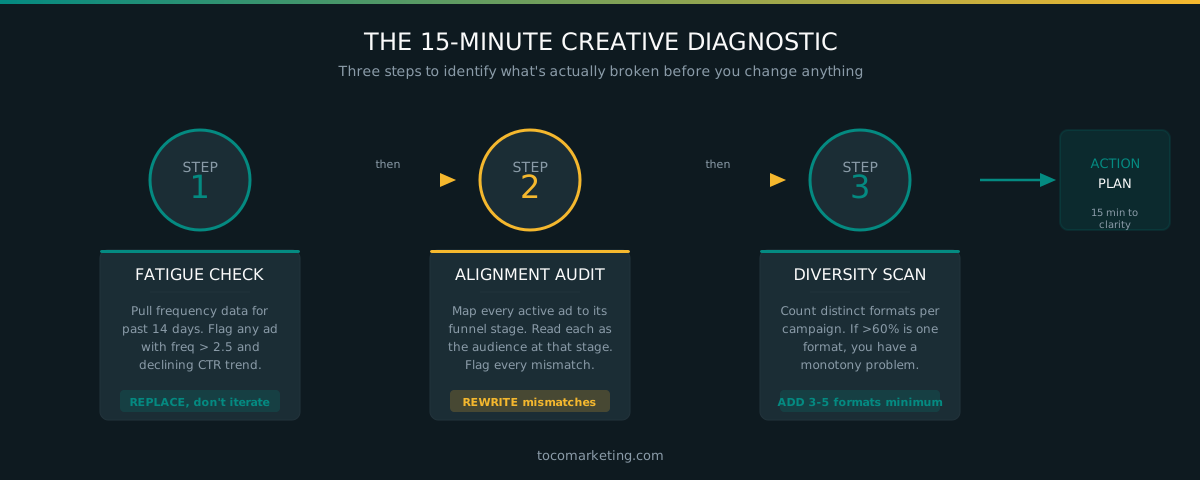
The first step is the Fatigue Check. Pull your frequency data for the past 14 days. Any ad with a frequency above 2.5 and a declining CTR trend is fatigued. Flag it for replacement, not iteration. You cannot optimise your way out of fatigue.
The second step is the Alignment Audit. Map every active ad to the funnel stage it is supposed to serve. Then read the creative as if you were the audience at that stage. Does a top-of-funnel ad name a problem the viewer recognises? Does a mid-funnel ad provide proof? Does a bottom-of-funnel ad make the next action obvious and low-friction? Any mismatch goes on the rewrite list.
The third step is the Diversity Scan. Count the number of genuinely distinct creative formats running in each campaign. If more than 60% of your active ads are the same format, you have a monotony problem. The goal is a minimum of three distinct formats per campaign, ideally five.
This diagnostic won’t tell you what to make next. But it will tell you what is broken now, and that is the only starting point that matters.
Building a Creative System That Doesn’t Break
Diagnosing the problem once is useful. Building a system that prevents the problem from recurring is transformative. The difference between brands that maintain consistent performance and brands that lurch from crisis to crisis is almost never talent or budget. It is process.
The system I build for clients at Toco has three layers.
The first layer is the Creative Calendar, a rolling production schedule that ensures new creative enters the pipeline before old creative fatigues. For most brands spending over £50k a month, that means producing and launching a minimum of eight to twelve new creative variants every two weeks. The calendar is mapped to funnel stages, so each batch includes pieces for awareness, consideration, and conversion.
The second layer is the Testing Protocol. Every new batch goes through a structured test in a dedicated testing campaign. We test one variable per batch, whether that is the opening hook, the format, the value proposition, or the visual style. Winners graduate to the scaling campaigns. Losers get analysed for learnings before being retired. The cycle repeats.
The third layer is the Performance Dashboard. Not the default Meta Ads Manager view, which buries creative-level insights under campaign-level metrics. A custom view that surfaces the metrics that actually matter for creative health: frequency trend, thumb-stop rate, hold rate, CTR by funnel stage, and cost per result by creative variant. You cannot manage what you cannot see, and Meta’s default reporting is designed to make you spend more, not spend better.
The Three Tests Every Ad Must Pass
Before any ad enters the pipeline at Toco, it has to pass three tests. These are fast, qualitative checks that catch the most common mistakes before a single pound of budget gets spent.
The first is the Scroll Test. Show the ad to someone who has never seen it, give them two seconds, and ask them what it is about. If they cannot answer, the hook is too weak. Two seconds is generous. On a feed, you get about 1.5.
The second is the So What Test. Read the ad’s core message out loud and ask, genuinely, “so what?” If the answer is not immediately obvious, the value proposition is unclear or the benefit is too abstract. “We use AI-powered targeting” fails the So What Test. “We cut your customer acquisition cost by 30% in 90 days” passes it.
The third is the Stage Test. Ask whether this ad would make sense to someone who has never heard of the brand, someone who visited the site last week, and someone who abandoned their cart yesterday. If the answer is yes to all three, the ad is not specific enough. Every ad should be built for one stage and feel slightly wrong for the others.
Common Mistakes That Keep Creative Broken
Optimising Around a Winner Instead of Replacing It
The most dangerous moment in a creative lifecycle is when an ad is performing well. Teams naturally want to protect it, to build around it, to squeeze every last drop of performance from it. But a winner is a depreciating asset. The moment performance peaks, the countdown to fatigue has already started. The correct response to a winning ad is not to protect it. It is to study why it won, extract the principles, and produce the next three variations before the original burns out.
Confusing Volume With Diversity
Launching twenty ads that are all slight variations of the same concept is not creative diversity. It is volume masquerading as strategy. The algorithm does not need more of the same. It needs genuinely different approaches, different formats, different hooks, different emotional registers. One UGC testimonial, one data-driven explainer, one lifestyle video, and one provocative static image will outperform twenty variations of the same product shot every time.
Treating Creative as a Design Task Instead of a Strategy Task
When creative briefs go straight to designers without strategic input, you get ads that look great and convert poorly. The brief should specify the audience’s awareness stage, the single message the ad needs to communicate, the action it should drive, and the objection it needs to overcome. Design is execution. Strategy is the thinking that makes execution effective. Most underperforming accounts have a design team but no creative strategist, and the gap between those two roles is where performance goes to die.
Where to Start Tomorrow
If your ads are underperforming and you’ve been cycling through targeting changes and bid adjustments without improvement, stop. Pull up your creative tab and run the three-step diagnostic. Check frequency, audit funnel alignment, and scan for format diversity. Whatever the diagnostic reveals, address it in that order. Fatigue is the most urgent because it is actively burning budget. Alignment is next because it determines whether new creative will actually work. Diversity comes last because it multiplies the impact of everything else.
Then build the calendar. Map your production capacity against the refresh cadence your spend level requires. If you’re spending over £100k a month and producing fewer than ten new creative variants every two weeks, you are underproducing. Staff up, bring in a creative partner, or automate parts of the pipeline. The cost of underproduction is always higher than the cost of production.
Creative is not a department. It is not a deliverable. It is the operating system of modern paid media. In a world where Meta’s algorithm handles targeting, bidding, and placement automatically, creative is the only lever you fully control. Every week you spend optimising around broken creative is a week of budget you will never recover.
Sources
- Nielsen — When It Comes to Advertising Effectiveness, What Is Key? — Nielsen Catalina Solutions study of 500 campaigns finding creative drives 47–49% of sales lift.
- NCSolutions — The Five Keys to Advertising Effectiveness — Meta-analysis confirming creative as the single largest driver of incremental sales.
- Shno — Ad Fatigue Statistics 2026 — Compiled statistics on creative fatigue impact: 50% CTR decline, 45% conversion drop after four exposures, 22% brand recommendation decrease.
- SuperAds — Why Creative Diversity Is the #1 Performance Lever in 2026 — Data on Meta’s Andromeda algorithm attributing 56% of performance outcomes to creative quality, and 25-creative ad set outperformance data.
- Ryze AI — Meta Ads Dynamic Creative Fixes 2026 — Frequency threshold data and 40% CTR advantage for biweekly creative refresh cycles.
- ATTN Agency — Systematic Creative Testing — Analysis of 50,000+ creative tests across 200+ DTC brands showing 2–3x performance advantage from systematic testing.
- Recast — Creative Performance Drives 47% of Sales — Additional analysis on the perception gap between how brands value creative (19%) versus its actual impact (49%).
At Toco Marketing, we specialise in growth and marketing strategies that deliver measurable results. Want to drive more engagement and conversions? Book a chat today, and let’s build a strategy that works for your busin