
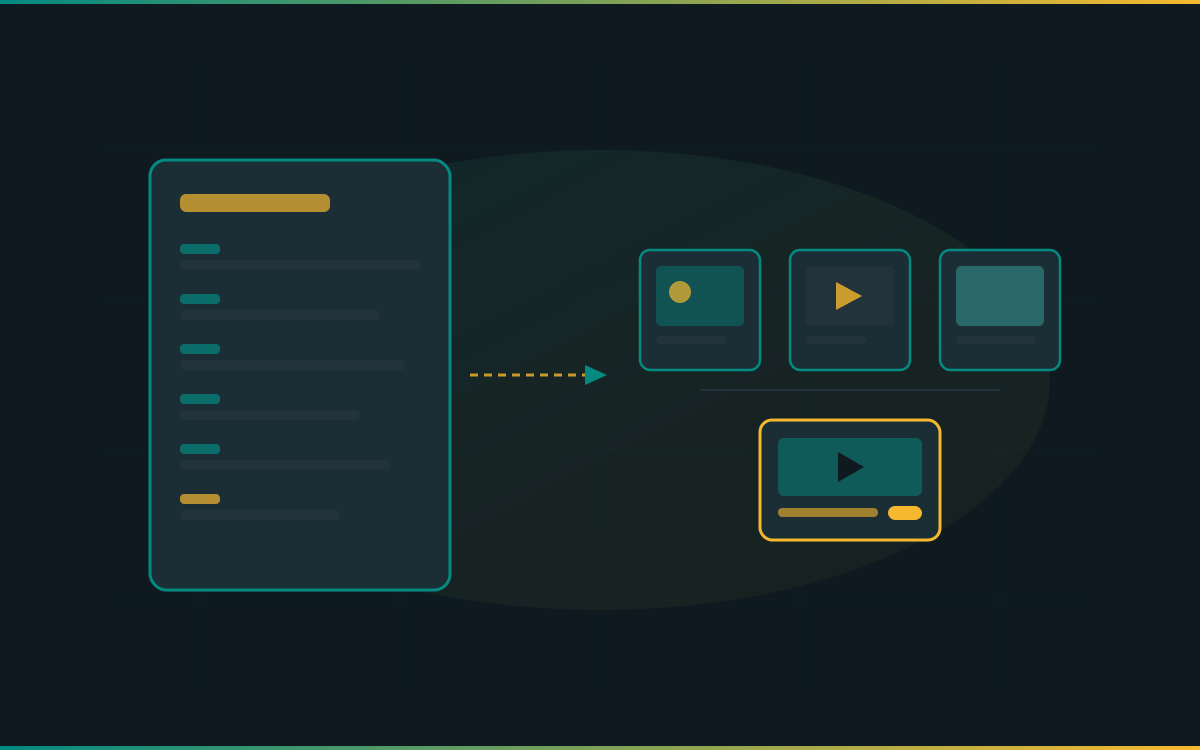
TL;DR: A blank creative brief is where performance goes to die. The ads that work don’t start from nothing. They start from a concept that has already won somewhere, get matched to a copywriting framework that fits the buyer’s awareness stage, and are written like you’d explain them to a friend at the pub. Then they ship as at least two genuinely different variations so the algorithm has room to find a winner. This is the briefing method we use at Toco.
The Gap Where Performance Goes to Die
There’s a particular failure mode I see in almost every underperforming account. There’s a design team, there’s a media team, and there’s nothing in between. Briefs arrive as a Slack message (“we need some new ads for the spring push”) and a folder of brand assets. The designers do their best with no strategy, the ads look polished, and they convert like wallpaper.
Design is execution. Strategy is the thinking that makes execution effective. The brief is the bridge between them, and when the bridge is missing, talent on either side can’t save the result. A designer can’t infer the buyer’s awareness stage from a brand guideline, and a media buyer can’t fix a weak concept by adjusting a bid. The decisions that decide whether an ad works happen at the brief, or they don’t happen at all.
So here is how we actually brief, step by step.
Start From a Proven Concept, Not a Blank Page
The blank page is the enemy. We keep a library of creative concepts that have already won, each one stripped down to its transferable pattern: the hook mechanic, the structure, the bit of persuasion psychology that did the work, with the brand and product specifics peeled away. Crucially, a concept only earns the “proven” label when there’s data behind it, a real ad on a real account that beat the average, recorded as evidence (“CPA £14 against a £23 account average”, for instance).
When we brief a new ad, the first move is to shortlist concepts whose funnel stage, format, and best-fit audience match the job, then adapt the strongest one to the brand’s persona. That single habit removes most of the risk, because you’re not gambling on an untested idea. You’re translating a known winner to a new context. The blank-page brief asks “what should we make?” The concept-led brief asks “which proven pattern fits, and how do we adapt it?”
Choose the Framework by Awareness Stage
Once you have a concept, you pick the copywriting framework that fits where the buyer is in Eugene Schwartz’s awareness ladder. The framework is not decoration. It dictates the order in which the ad makes its argument.
| Goal | Framework | Awareness stage |
|---|---|---|
| Top of funnel, viral reach | AIDA (Attention, Interest, Desire, Action) | Unaware to problem-aware |
| Direct sales, closing | PAS (Problem, Agitation, Solution) | Problem to solution-aware |
| Visual transformation | BAB (Before, After, Bridge) | Solution to product-aware |
| B2B and high ticket | The 4 C’s (Clear, Concise, Compelling, Credible) | Product-aware to most-aware |
Running PAS at someone who doesn’t yet know they have a problem is wasted budget, and so is running a slow brand film at someone who visited your pricing page yesterday. Match the framework to the stage and the ad starts doing the right job.
Write It Like Bar Talk
Nobody talks about specs in real life. They talk about feelings, problems, and stories. So the rule we write to is simple: say it the way you’d explain it to a smart but impatient friend at the pub.
A few of the rules that keep copy honest:
- No corporate jargon. If it sounds like a brochure (“core memory”, “high quality”, “ergonomic”), kill it and translate to plain speech (“something to keep”, “properly made”, “feels nice to hold”).
- Press one emotion. Every line should press fear, pride, or relief, and aim at identity rather than the surface inconvenience.
- The bar test. If you said the sentence to a friend after two drinks and they’d wince, rewrite it.
- Be concrete. “Saves you 47 minutes of charging a day” sticks where “fast charging” slides off.
- Earn trust with one big proof, not twenty small ones. A single verifiable proof point does more than a page of claims.
- Never invent. No made-up numbers, guarantees, or materials. If a specific fact isn’t in the brand’s context, use an honest, emotive phrase instead.
The Pivot, and Why We Shoot Lo-Fi
Two execution rules matter more than the rest.
The first is the Pivot. A hook that only shows the product gets scrolled past. The hook has to pivot into the mechanism, the reason the product solves the problem, moving from a messy, frustrating reality to a clear, tactile bit of proof. The viewer needs to see why it works, not just that it exists.
The second is friction engineering. Real, slightly messy settings build more trust than a polished studio, especially in considered and skeptical categories. Lo-Fi is not lazy. It’s a deliberate choice that reads as honest, which is why it so often beats the expensive shoot.
Build It as a Beat Sheet
A concept and a framework still need a structure a producer can actually shoot. We write that as a beat sheet: the ad broken down beat by beat, so nothing is left to a guess on the day. For video, that looks like this:
CONCEPT: [proven concept name]   FRAMEWORK: [PAS / AIDA / BAB / 4 C's]
PERSONA: [who, and what they already believe]   AWARENESS: [stage]
MOTIVATOR: [the psychological entry point for this variation]

| Beat | Time  | Visual / clip action      | Voiceover            | On-screen text |
|------|-------|---------------------------|----------------------|----------------|
| 1    | 0–2s  | Hook + the pattern break  | ...                  | ...            |
| 2    | 2–6s  | The Pivot to the mechanism| ...                  | ...            |
| 3    | 6–12s | Proof / demonstration     | ...                  | ...            |
| 4    | 12s+  | Single clear call to action| ...                 | ...            |
For a static, the brief names the visual layout (background, composition, any native UI), the textual hook (the scroll-stopping line on the image), and the body (proof points, or “N/A” if it’s hook-only, stated deliberately so the omission reads as a choice).
The point of writing it this way is that a stranger could shoot it and land the same ad you had in your head. That is the test of a brief that gets made.
Ship at Least Two Truly Diverse Variations
A brief should never produce a single asset. It should produce a batch, and the variations have to be genuinely different, not cosmetic text swaps on one product shot. Meta’s Andromeda algorithm penalises near-duplicates and rewards real variety, so each variation should enter through a different psychological door. We pull from ten motivators:
pain point, pleasure or aspiration, social proof, curiosity, fear or urgency, identity, feature-led, problem and solution, authority or expert, and comparison.
Two variations of the same concept, one led by social proof and one by curiosity, with different opening visuals, give the algorithm two real options. The same headline in two fonts gives it one. This is the executional side of the argument we make in full in our piece on creative diversity, where creative genuinely is the new targeting. How many variations a batch needs is a budget question, and our Creative Volume Calculator turns your spend and target CPA into a number.
Tag It So You Can Read It Back
The last step of a good brief is making the ad legible after it runs. Tag every asset with its concept name, format, execution style, creative focus, and awareness stage. Consistent tags are what let a creative report parse performance and place each ad on the Creative Performance Matrix, so you learn which concepts, formats, and motivators actually won and feed that back into the next brief. A brief that can’t be read back teaches you nothing. Before anything is built, also confirm it respects each placement’s safe zones, which you can check against the live interface in our Safe Zone Checker.
Where to Start Tomorrow
Take the next creative request that lands as a one-line Slack message and refuse to brief it that way. Start from a concept that has already won, choose the framework that matches the buyer’s awareness, write the copy like bar talk, lay it out as a beat sheet, and ship two genuinely different variations. Then tag them so next month’s report can tell you what worked.
A single great brief is good. A library of proven concepts that you adapt, measure, and feed back is how you build performance that compounds. That wider system is the subject of our guide to building a messaging architecture that converts, and the volume it needs to run on is covered in creative volume as a growth lever.
Sources
- Nielsen: When It Comes to Advertising Effectiveness, What Is Key?. Study establishing creative as the largest single driver of campaign sales lift.
- SuperAds: Why Creative Diversity Is the #1 Performance Lever in 2026. Data on Meta’s Andromeda algorithm rewarding genuinely diverse creative and penalising near-duplicates.
- ATTN Agency: Systematic Creative Testing. Evidence that structured, variable-controlled creative beats intuition-led production by 2 to 3x.
At Toco Marketing, we specialise in growth and marketing strategies that deliver measurable results. Want briefs that start from proven concepts and ship ads that perform? Book a chat today, and let’s build a strategy that works for your business.