

TL;DR: “Should we run statics or video?” is the wrong question. Meta’s Andromeda algorithm now attributes around 56% of performance outcomes to creative, and it rewards genuine variety: advertisers running one ad set of 25 diverse creatives outperformed those running five ad sets of five similar creatives by 17% on conversions and 16% on cost efficiency. The winning brands don’t choose static, video, or UGC. They run a deliberate mix, weighted to their business. This is how we build that mix at Toco.
The Format War Is a Distraction
Walk into almost any growth meeting and someone will be defending a format. The performance marketer wants more video because it gets cheaper reach. The brand lead wants polished statics because they protect the look. The founder saw a UGC ad outperform everything last quarter and now wants UGC for everything.
Everyone is arguing about the wrong thing. The winning format is whichever one the algorithm can match to the right person, in the right placement, at the right moment. The only way to give the algorithm that range is to feed it variety. Format monotony, running five versions of the same static with different headlines, starves the system of the permutations it needs to find winners. It’s one of the four ways creative quietly fails, which we break down in why your ad creative is failing.
The data is consistent on this. Variety drives performance, and it does so reliably enough to plan around.
What Each Format Is Actually Good At
Before you can build a mix, you need to know what each format does well. Not in the abstract, but in the auction.
Hi-fi static
A polished, designed static image is your workhorse for clarity. It communicates a single idea in under two seconds, it’s cheap to produce in volume, and it’s hard to beat for offer-led and feature-led messages where the value is obvious at a glance. Statics also carry your brand world better than any other format, through typography, colour, and composition you fully control. The limitation is emotional range. A static states; it rarely tells a story.
Low-fi static
The screenshot, the text-on-background, the “ugly” ad that looks like it was made in a notes app. Low-fi statics work because they don’t read as advertising. They suit social proof, founder messages, and provocative hooks that earn a second of attention precisely because they don’t look produced. They’re also the fastest format to test new angles in, because production cost is near zero.
Low-fi video
Native, hand-held, sound-on video, the format that feels like content rather than a commercial. This is where most thumb-stopping happens. Low-fi video is the engine of top-of-funnel discovery because it blends into the feed and gives you room to land a hook in the first 1.5 seconds. It’s also where you test messaging at speed.
Hi-fi video
Produced video with proper lighting, editing, and pacing. This is your credibility format, used for product demonstrations, brand films, and the considered pieces that carry weight at the consideration stage. It’s the most expensive to produce, so it earns its place through longevity and trust rather than volume.
UGC
Creator-style content sits across low-fi video and low-fi static, but it deserves its own line because it does something the others can’t. It borrows trust. A real person speaking to camera reads as a recommendation rather than a pitch. UGC is your highest-leverage format for skeptical categories and consideration-stage objections, but only when it feels authentic. The moment it looks scripted, it loses the one advantage it had.
The Matrix We Read in Every Creative Report
Every month we plot a brand’s live ads on what we call the Creative Performance Matrix, the same quadrant view that sits in our creative reports. The two axes come straight from how Meta’s algorithm treats creative. The horizontal axis is execution, with polished Hi-Fi work on the left and native Lo-Fi or UGC on the right. The vertical axis is format, with image and static at the top and video at the bottom. Each ad is a bubble sized by the conversions it drove, and the dead centre is the Graveyard, where low-spend, low-efficiency ads pile up.
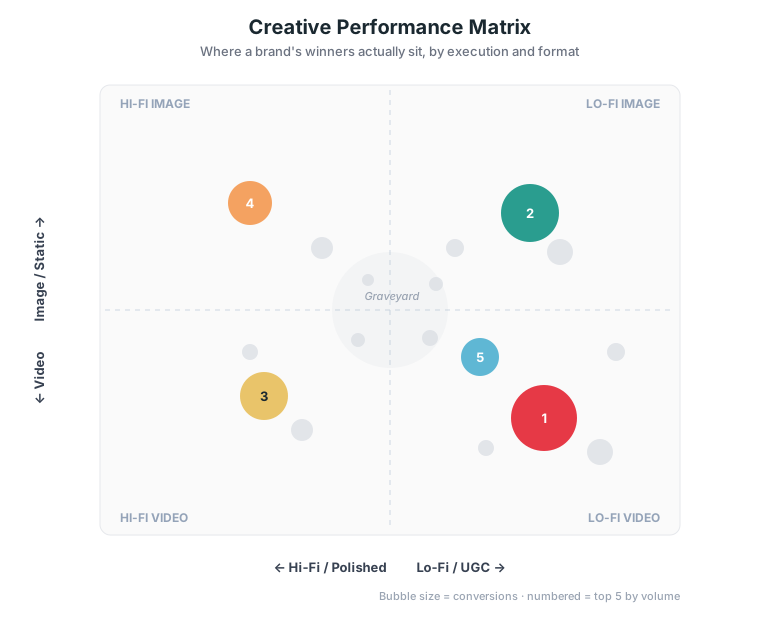
The four corners are the four formats from the last section, and the pattern we want to see is the one in the chart: the biggest winners scattered across more than one quadrant. When a brand’s top bubbles all cluster in a single corner, the monotony problem is made visible, and it usually means the account is one algorithm shift away from an efficiency drop. A healthy account has proven winners in several quadrants, which is diversity doing its job in a single picture.
The Mix Is Weighted to Your Business
Here’s where most “run more video” advice falls down. The right mix depends on whether you sell to consumers or businesses, because the two buy completely differently. We bake this weighting into our Creative Volume Calculator, and the logic is worth understanding.
For a B2C brand, the centre of gravity is native and emotional. Our default starting split:
- Hi-fi static: 30%
- Low-fi video: 30%
- Hi-fi video: 20%
- Low-fi statics: 20%
Half your output is video-led, because consumer discovery happens in motion. The statics do the clarity and offer work; the low-fi pieces keep the testing engine fed.
For a B2B brand, the weighting shifts hard toward clarity and credibility:
- Hi-fi static: 50%
- Hi-fi video: 30%
- Low-fi video: 10%
- Low-fi statics: 10%
A business buyer scrolling LinkedIn or Meta wants the value proposition stated cleanly and the credibility established quickly. Polished statics and produced video do that; the low-fi formats play a supporting role.
These are starting points rather than commandments. The split moves with your category, your funnel stage, and what your testing reveals. But notice what both have in common: no single format exceeds half the output, and every mix runs at least four formats. That’s the principle. The exact percentages are a refinement.
Treat Diversity as a Strategic Stance
There’s a deeper point here, and it’s the one we’ll argue every time. Creative diversity works as a position about how modern paid media operates, not just as a clever optimisation.
In a world where Meta automates targeting, bidding, and placement, the brand’s job is to supply the algorithm with the richest possible set of inputs and let it find the matches. A brand that runs one format is betting that it knows, in advance, which message-format-placement combination will win. It doesn’t. Nobody does. The brands that win are the ones that stop betting and start supplying range.
This is why we resist the single-format pull, however well-intentioned. The founder who wants “all UGC” because one UGC ad popped is pattern-matching on a winner, the same trap that makes teams cling to a fatiguing ad instead of replacing it. One format winning today is an argument for keeping that format in the mix, not for collapsing the mix around it.
Avoiding Fake Diversity
A warning, because this is the most common way the principle gets misapplied. Running twenty ads isn’t diversity if all twenty are the same concept with different headlines. That’s volume in disguise, and the algorithm sees straight through it.
Genuine diversity means different formats, different hooks, and different emotional registers. One UGC testimonial, one data-led explainer static, one lifestyle low-fi video, and one provocative text-on-background ad give the system four genuinely different doors to walk a customer through. Four headline swaps on one product shot give it one door painted four colours.
When you plan a batch, the test is simple. If you described each ad in one sentence to a stranger, would the sentences sound different? If they all sound the same, you have monotony rather than a mix.
Where to Start Tomorrow
Audit your active creatives and tag each by format. If more than 60% of your spend sits in one format, you have a monotony problem that’s costing you efficiency right now. Then rebuild the next batch against a weighted split. Start with the B2C or B2B defaults above, adjust for your funnel, and make sure no concept repeats more than necessary. Size that batch against your budget with our creative volume guide, and build each variation from a different angle using the method in how to write a creative brief that gets made.
Then hold the line when someone asks you to bet the account on a single format. The static-versus-video debate has a winner, and it’s neither. It’s the brand disciplined enough to run both, plus UGC, plus the low-fi stuff that looks like it shouldn’t work, all at once.
Sources
- SuperAds: Why Creative Diversity Is the #1 Performance Lever in 2026. Data on Meta’s Andromeda algorithm attributing around 56% of outcomes to creative, and the 25-creative ad set outperforming 5×5 by 17% on conversions and 16% on cost efficiency.
- Nielsen: When It Comes to Advertising Effectiveness, What Is Key?. Foundational study finding creative drives the largest share of sales lift.
- Recast: Creative Performance Drives 47% of Sales. Analysis of the gap between how brands value creative and its actual impact on performance.
At Toco Marketing, we specialise in growth and marketing strategies that deliver measurable results. Want a creative mix built to feed the algorithm rather than starve it? Book a chat today, and let’s build a strategy that works for your business.