TL;DR: “In-house or agency?” is usually asked as a cost question. It is a capacity question first: can this option produce the number and variety of ads your budget needs, every month? Two in-house hires, a graphic designer and a motion designer, cost about £81,300 a year in the UK once employer National Insurance and pension are added, and that still leaves strategy and anyone on camera uncovered. Ten freelance days a month come to about £3,770. Design subscriptions start under £1,000 a month but only produce what you brief. Most brands end up with a mix. Below are the numbers, where each option wins, and the questions to ask before you choose.
The Question Behind “In-House or Agency?”
Most founders I speak to frame this as a cost comparison. One salary against one retainer, pick the smaller number.
That skips the first step. Before comparing prices, work out what you are buying. In the worked example in our guide to creative volume, a B2C brand spending £10,000 a month on Meta at an £83 target CPA needs roughly 17 new test creatives every month. Those 17 should not be one idea resized: the mix works out to about five statics, five low-fi videos, three produced videos and three quick text-led pieces. Your own number will differ, and the Creative Volume Calculator will give it to you in a minute.
So the real question is which option can deliver that number, in that variety, month after month, at a cost you can carry.
What the Job Actually Involves
Ad creative production for paid social is four jobs, and any option that covers one of them leaves the other three with you.
- Strategy. Someone has to decide what gets made and why: which persona, which angle, which funnel stage, what the test is meant to prove. This is the role most teams are missing, and it is the difference between a creative brief that gets made and a one-line Slack message.
- Production across formats. Statics, short-form video and creator-style content with real people in it. An account where every ad looks the same has a problem that more volume won’t fix, as we cover in static vs video vs UGC.
- Testing and reading the results. New creative has to go into a structured test, and somebody has to read what won and feed it into the next brief.
- Refreshing before fatigue. Winners wear out. The replacement has to be in production before the current ad tips over, which you can check with the Creative Fatigue Calculator.
Keep those four in mind as you read the options. The cheapest ones cover production only.
Option 1: Hire In-House
Start with the smallest team that can make both statics and video: one graphic designer and one motion designer.
Robert Half’s 2027 UK Salary Guide puts the midpoint (50th percentile) salary at £33,750 for a graphic designer and £36,750 for a motion designer. On top of salary, an employer pays National Insurance at 15% on earnings above £5,000 and a minimum pension contribution of 3% on earnings between £6,240 and £50,270.
| Graphic designer | Motion designer | |
|---|---|---|
| Salary (UK midpoint) | £33,750 | £36,750 |
| Employer National Insurance | £4,313 | £4,763 |
| Minimum employer pension | £825 | £915 |
| Cost to the business | £38,888 | £42,428 |
Together that is about £81,300 a year, or roughly £6,800 a month. It leaves out software, equipment, recruitment fees, holiday cover and the time someone spends managing them. Smaller employers can often offset part of the National Insurance through the Employment Allowance.
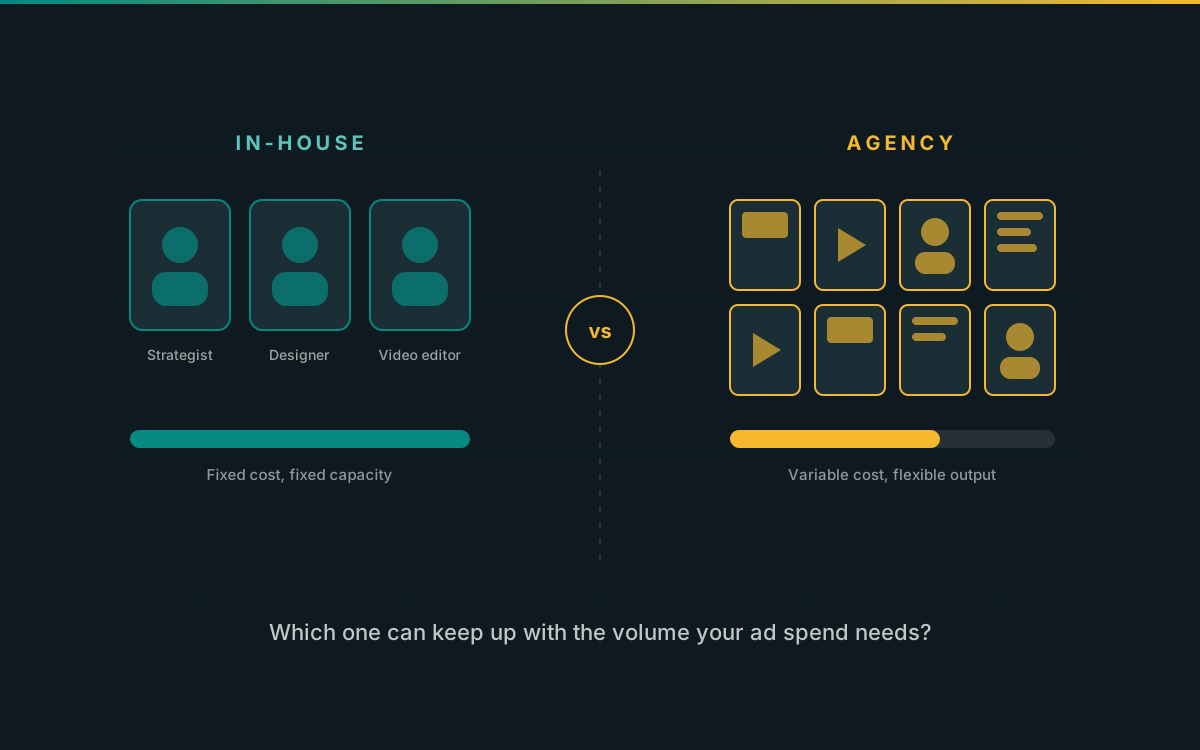
What you get is real: people who know the product, same-day changes and a consistent brand. What those two hires don’t give you is a strategist, creators or anyone on camera, and cover when one of them is off or leaves. Two people are also a fixed ceiling. If your budget doubles, your output doesn’t.
Two more numbers are worth knowing before you commit. In the State of In-housing 2023 study from Alchemists, ISBA and CvE, 93% of respondents expected in-housing to make them faster and 40% experienced it. Likewise, 93% expected better cost effectiveness and 60% experienced it. And hiring takes time: Totaljobs’ 2026 survey of 885 UK employers put the average time to hire at 12 weeks, across all sectors.
Option 2: Use Freelancers
Freelancers turn that fixed cost into a variable one. YunoJuno’s 2026 Freelancer Rates Report gives average day rates of £348 for a graphic designer, £385 for a motion graphics designer and £417 for a creative strategist.
Ten days a month, split as four design days, four motion days and two strategy days, comes to about £3,770. You pay no on-costs and you can scale the days up or down.
The cost that doesn’t show on the invoice is management. Somebody on your side writes the briefs, chases availability and checks the work. Knowledge of what worked last month sits in a freelancer’s head and leaves when they take another booking. And if everything runs through one freelancer, you have the single-source dependency we warn about in our guide to scalable creative strategy.
Option 3: Buy a Design Subscription
Subscription services sell design capacity for a flat monthly fee. In the UK, Design Cloud’s graphic design plans run from £699 to £1,099 a month before VAT on a rolling monthly contract. At the enterprise end, Superside’s subscriptions start at a $15,000 monthly minimum on an annual term.
These services are production capacity. You submit a brief and get designs back. Deciding what to test, and reading what the results mean, stays with you. That makes a subscription a good fit when you already have a strategist and need more hands, and a poor fit when the thing you are missing is the thinking.
Option 4: Work With an Agency
An agency should cover all four jobs: strategy, production across formats, testing and refresh. When the same team also runs your media, creative and performance data sit in one place, which shortens the loop between “this won” and “make more like it”.
Agencies rarely publish prices, so compare them on what a finished, usable ad costs and what is included. Check whether extra hooks and variations are charged, and whether the fee rises with your ad spend.
The trade-offs are real too. An agency is not in your building. It takes a few weeks to learn the product. Quality varies widely between agencies. And you still need one person on your side who owns the relationship and signs things off.
Creator Content Costs Extra in Every Model
Whichever route you choose, ads with real people in them are usually bought per video. In the UK, Twirl prices UGC from £240 a video with a minimum purchase of four. Billo’s videos start at $99 for a 15-second video from a regular creator with basic editing. Add this to the in-house, freelance and subscription numbers above, because none of them include it.
The Numbers Side by Side
| Option | Published cost | What it covers |
|---|---|---|
| Two in-house hires (graphic and motion designer) | About £6,800 a month with on-costs | Statics and video editing |
| Ten freelance days a month | About £3,770 | Design, motion and two days of strategy |
| Design subscription (UK) | £699 to £1,099 a month before VAT | Design from your briefs |
| Enterprise creative subscription | From $15,000 a month | Creative production from your briefs |
| Creator videos | From £240 a video (Twirl) or $99 (Billo) | One video each |
| Agency | Rarely published; ask for the cost per finished ad | Strategy, production, testing and refresh, if it is a good one |
When Each One Wins
In-house wins when your volume is high and steady all year, when the work needs daily access to the product or the founders, and when you can afford the strategist as well as the makers. A team without the strategist produces good-looking ads that test nothing.
Freelancers win when you have the strategy in-house and need specific craft in bursts, such as a motion designer for a launch.
A subscription wins when you need a steady flow of statics and you can write a clear brief for every one.
An agency wins when you need strategy and several formats now, when your volume moves up and down with the seasons, or when you would rather not build and manage a studio.
Most brands end up with more than one. In the ANA’s 2023 survey, 82% of members had an in-house agency and 92% of respondents also worked with external agencies. The WFA’s 2023 study of 45 multinationals found that 66% had in-house agencies, and that talent attraction and retention were a problem for 20%. A common split is an in-house lead who owns the brand and the brief, with outside production for volume and for formats the team can’t make.
Seven Questions to Ask Before You Choose
- How many new ads a month does my budget need, and in which formats?
- Who decides what gets made, and what data do they use?
- Can this option put real people on camera?
- What does one finished, usable ad cost, including extra hooks and variations?
- What happens when someone is ill, on holiday or leaves?
- How long is it from brief to live?
- Is the price tied to my ad spend?
If an option can’t answer the first three, the price doesn’t matter.
Where We Fit, and Where We Don’t
We are an agency, so weigh this section accordingly.
Our creative production runs on a flat monthly allocation of Toco Tokens: one token for a static, two for a video, four for a UGC piece. Extra hooks and variations are included, and the fee is never tied to ad spend. Work ships in two-week sprints, planned by a creative strategist, and we produce for accounts we manage as well as for brands whose media is run in-house or by another agency. When we took over Meta management and creative production for Goodnick, in-platform customer acquisition cost halved in three months.
We are the wrong choice in two cases. If you need someone in the building every day, hire. And if you already have a strategist and only need overflow statics, a subscription or a freelancer will cost you less.
Where to Start This Week
Run your numbers through the Creative Volume Calculator to get your monthly target. Then write down who does each of the four jobs today: strategy, production, testing and refresh. The gaps in that list tell you what to buy, and the tables above tell you roughly what it costs.
Sources
- Robert Half: 2027 UK Marketing and Creative Salary Guide. 25th, 50th and 75th percentile salaries for graphic designers and motion designers.
- GOV.UK: Rates and thresholds for employers 2026 to 2027. Employer National Insurance rate and secondary threshold.
- GOV.UK: Workplace pensions, what you, your employer and the government pay. Minimum employer contribution and qualifying earnings band.
- YunoJuno: 2026 Freelancer Rates Report. Average day rates for design and strategy roles.
- Design Cloud: pricing. UK design subscription plans, excluding VAT.
- Superside: pricing. Subscription minimum and term.
- Twirl: pricing and Billo: pricing. Per-video prices for creator content.
- ISBA, Alchemists and CvE: The State of In-housing 2023. Expected against experienced benefits of in-housing among UK advertisers.
- ANA: 2023 in-house agency survey. Share of members with an in-house agency and use of external agencies.
- WFA and Observatory International: in-housing at major multinationals. In-house agency adoption and talent challenges.
- Totaljobs: Hiring Trends Index. Average time to hire among UK employers.
At Toco Marketing, we specialise in growth and marketing strategies that deliver measurable results. Want to work out which mix of in-house and outside production fits your budget? Book a chat today, and let’s build a strategy that works for your business.